
Science fiction is often associated with distant planets, intelligent machines, futuristic cities and technologies that do not yet exist. However, the most memorable science fiction does much more than predict the future. It examines the present. It takes the fears, inequalities, prejudices and moral conflicts of today and places them in unfamiliar worlds so that readers can see them from a new perspective.
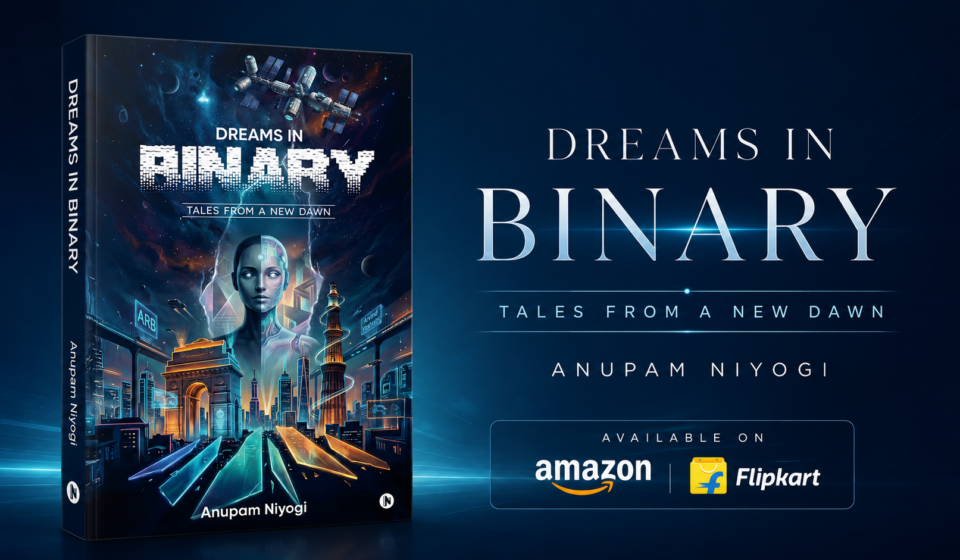
Anupam Niyogi’s Dreams in Binary: Tales From a New Dawn belongs to this more thoughtful tradition of speculative storytelling. Published by Notion Press in February 2026, the English-language collection contains seven stories across 208 pages. Its fictional landscape stretches from the ancient ghats of Varanasi to the vast loneliness of outer space. Along the way, it explores identity, homophobia, war, morality and the complicated relationship between human beings and technological progress.
That combination immediately gives the book an identity of its own. It is not simply a collection about machines, spaceships or imagined inventions. Technology provides the setting, but human behaviour remains the real subject.
Seven Stories Connected by One Larger Question
A short-story collection offers a particular kind of reading experience. Instead of asking readers to remain inside one plot for hundreds of pages, it opens several doors. Every story introduces a different situation, conflict and emotional atmosphere. Yet the strongest collections create a hidden connection between these apparently separate worlds.
In Dreams in Binary, that connection appears to be a persistent question: What remains of our humanity when the world around us changes?
A society may become technologically advanced, but does that automatically make it compassionate? People may travel beyond Earth, build intelligent systems and transform the physical world, but will they overcome prejudice, hypocrisy and violence? Or will they carry the same old divisions into every new future they create?
These questions make the collection relevant even for readers who do not usually choose science fiction. The book’s subjects are not limited to laboratories and futuristic cities. They include acceptance, loneliness, power, identity, social judgement and the destructive repetition of war. These are deeply human concerns.
Science Fiction Rooted in Social Reality
One of the book’s most promising qualities is its willingness to address uncomfortable social issues through imaginative fiction. Its official description specifically identifies homophobia, questions of identity, the futility of war and moral hypocrisy among its central concerns.
These themes matter because speculative fiction gives writers a unique form of freedom. A realistic story may directly reproduce the arguments and divisions of contemporary society. Science fiction, however, can redesign the environment completely. It can move the reader into another century, another civilization or another part of the universe while preserving the emotional truth of the problem.
This distance can make difficult subjects easier to examine. Readers may initially believe they are entering a fictional future, only to discover that the story is quietly asking them to reconsider the present.
The book’s movement between Varanasi and outer space is especially intriguing. Varanasi carries associations with history, belief, death, continuity and spiritual reflection. Outer space represents uncertainty, isolation and the unknown. Bringing these two imaginative territories into the same collection suggests an ambitious range. It places ancient questions beside futuristic possibilities and reminds us that technological change does not erase humanity’s oldest moral struggles.
Why the Book Can Be Called Underrated
Calling a book underrated should not be treated as a claim about verified sales figures. In this case, it is more accurately a statement about discoverability. Dreams in Binary is a recent publication, and the publicly available critical discussion surrounding it is still limited. Its February 2026 publication date means it is still finding its readers.
Books from emerging voices frequently face this problem. Readers tend to return to established authors because those names already carry familiarity. Bookstores, recommendation platforms and social-media discussions often reinforce the same popular titles. As a result, a thoughtful new work can remain outside the mainstream conversation, regardless of the originality of its ideas.
That is precisely why collections such as Dreams in Binary deserve deliberate attention. Reading an emerging author is not only an act of discovery; it is also an opportunity to encounter ideas before they have been simplified by widespread opinion. Readers can approach the stories without being told what to admire, what to dislike or how to interpret every ending.
The book also appears difficult to place inside a single narrow category. It combines speculative futures, social commentary, Indian settings, questions of identity and emotionally grounded storytelling. That genre-crossing quality is artistically valuable, although it can make a book harder to market. Readers looking only for conventional space adventures may overlook its social depth, while readers of literary fiction may not immediately recognise themselves as an audience for science fiction.
A Book for Both New and Experienced Science-Fiction Readers
The collection format makes the book approachable. Readers who feel uncertain about beginning a long science-fiction novel can enter one world at a time. A story can be read in a single sitting, considered independently and revisited later.
At the same time, experienced science-fiction readers may appreciate the effort to connect imagined technologies with questions of conscience. The book’s promotional description presents its speculative worlds as grounded, human and thought-provoking rather than dependent only on technical complexity.
That balance is important. Technology may create wonder, but characters create emotional investment. A futuristic concept becomes meaningful when it changes someone’s relationships, choices, fears or understanding of themselves. The lasting question is rarely “What can this machine do?” It is usually “What will people do with it?”
Why You Should Read It
Read Dreams in Binary for its range. Read it because it connects one of India’s most ancient cities with the unexplored silence of space. Read it because its seven stories appear interested not merely in what humanity may build, but in what humanity may become.
Most importantly, read it because science fiction is one of the most effective ways to examine reality without being restricted by it. A speculative story can entertain, unsettle and challenge the reader simultaneously. It can transform a distant future into a mirror.
Anupam Niyogi’s collection arrives at a time when conversations about artificial intelligence, identity, conflict, equality and technological responsibility are becoming increasingly urgent. Although its worlds may be imagined, the questions behind them are already here.
Dreams in Binary: Tales From a New Dawn deserves attention not simply as a new science-fiction release, but as a collection attempting to bring technology, society and human conscience into the same conversation.
Book details: Anupam Niyogi | English | Paperback | 208 pages | Notion Press | ISBN 9798902077381.
Buy the book: Dreams in Binary: Tales From a New Dawn on Amazon