
One of the most engaging features of Kaalchakra – The Cursed Prophecy is the scale of the world it proposes. Nikhil Rawal’s debut does not stop at borrowing recognizable imagery from Indian mythology for a conventional fantasy conflict. According to the supplied synopsis, its narrative moves across realms, ages, ancestral mysteries, and the threatened balance of creation itself. That is a demanding imaginative canvas, but also a rich one. Indian mythological traditions offer a language of cyclical time, moral obligation, cosmic forces, and transformation that can support stories beyond the familiar boundaries of a single kingdom or era. Rawal’s premise puts that capacity to work by positioning the personal fate of Vishwa within a much larger metaphysical order. The attraction is not merely the promise of magical powers; it is the suggestion of a universe in which action, time, and ethical consequence are inseparable.
The concept of Kaalchakra is particularly suited to this kind of storytelling. A wheel suggests movement and recurrence, but it also suggests that what appears to be an ending may belong to a larger pattern. In modern adventure fiction, time often operates as a ticking clock: a deadline approaches, and the hero must act. In an epic informed by cyclical thought, time can become the very structure of the mystery. An event from an earlier age may still exert force in the present; a prophecy may seem to describe a future already entangled with the past; a character may learn that belonging to a lineage is not equivalent to understanding it. These possibilities are compelling because they allow narrative suspense to arise from discovery rather than from pursuit alone. The reader is invited to wonder not only what happens next but how widely separated events may belong to one story.
Kaliyuga supplies the setting with an ethical temperature. The synopsis describes an age whose shadow is growing as the forces threatening Dharma gain strength. Even for readers unfamiliar with Hindu cosmological concepts, the dramatic idea is accessible: the fabric of right action is under pressure, and the crisis can no longer be treated as local or temporary. For readers with a familiarity with Indian traditions, the term introduces additional resonance. Kaliyuga is not simply a fictional dark season invented to raise the stakes; it is a culturally meaningful concept adapted into the story’s imagined conflict. An effective mythological fantasy uses such references with purpose. Their value comes from the questions they awaken about justice, corruption, duty, and the possibility of renewal, rather than from their exotic sound or visual grandeur.
Within this framework, the emergence of Vritra offers a powerful organizing threat. The book description identifies Vritra as an embodiment of evil, placing the character in opposition to the balance of Dharma and the continuation of creation. A conflict at that level has the clear outlines of epic fantasy: one force threatens order while another is called to resist it. But it also creates an artistic challenge. Cosmic antagonists can become abstractions if their power matters more than their motivation or the harm they cause. What makes this premise promising is its pairing of the immense antagonist with a protagonist whose entry point is personal pain. Vishwa has not simply volunteered for a grand war. The story’s described sequence suggests that the coming conflict intrudes upon a life already altered by tragedy, giving its mythic battle an immediate human consequence.
The novel also sets itself apart by explicitly allowing science-fiction elements to enter its mythology and fantasy. This is a potentially fruitful blend rather than an automatic contradiction. Science fiction commonly asks how systems operate and what possibilities emerge when familiar boundaries change. Mythological fantasy often asks what those systems mean and what obligations exist within them. Together, they can produce an imagined universe in which mysterious abilities and extraordinary realms create both technical curiosity and spiritual unease. The synopsis does not disclose particular devices, technologies, scientific theories, or rules of magic, so it would be speculative to describe a specific scientific mechanism. What can be appreciated is the stated ambition to cross genres, inviting readers to see ancient cosmological questions through a wider imaginative lens.
That hybridity may help the book reach readers who are drawn to epic fantasy but do not ordinarily seek out mythology-focused fiction. A reader of speculative adventure recognizes the excitement of discovering hidden powers, entering unfamiliar worlds, and confronting a danger greater than a single individual. A reader interested in Indian spiritual traditions recognizes a different set of attractions: cycles of time, the demands of Dharma, and the weight of karma. The protagonist stands between these modes. As an ordinary businessman, Vishwa can function as an accessible entry point into a universe that might otherwise seem forbidding. He shares the reader’s initial distance from the hidden legacy that awaits him. The process of his discovery therefore offers a possible path for introducing the world without requiring the audience to arrive already familiar with every mythological reference.
The idea of an ancient bloodline is another useful tool in this imagined architecture. In some fantasies, inherited destiny simply grants authority; the special descendant is important because ancestry says so. A more interesting approach lets inheritance become a question rather than an answer. What does a person owe to ancestors who made decisions before their birth? How much of identity is received, and how much must be earned? What happens when knowledge of a legacy changes the meaning of an apparently ordinary life? The synopsis points toward exactly these concerns by joining Vishwa’s lineage to an old prophecy that operates through generations. The concept creates the potential for family history to become world history, while leaving the hero’s choices as the element through which the past is challenged or continued.
The companion poem, The Wheel of Time, reinforces the work’s fascination with creation as a process rather than a fixed object. Its verses evoke worlds rising and falling, a guardian’s revolt against perceived corruption, and the possibility that stillness could itself become a form of annihilation. The poem is a separate supplied text, not a substitute for the complete novel, yet it illuminates a distinctive imaginative polarity: to preserve life is to preserve change, suffering, uncertainty, and possibility at once. This vision is richer than the uncomplicated equation of order with safety. If a character tried to halt the wheel to prevent suffering, that apparent promise of peace would raise an urgent question about what is lost when movement and growth are denied. Such ideas give cosmic fantasy philosophical texture.
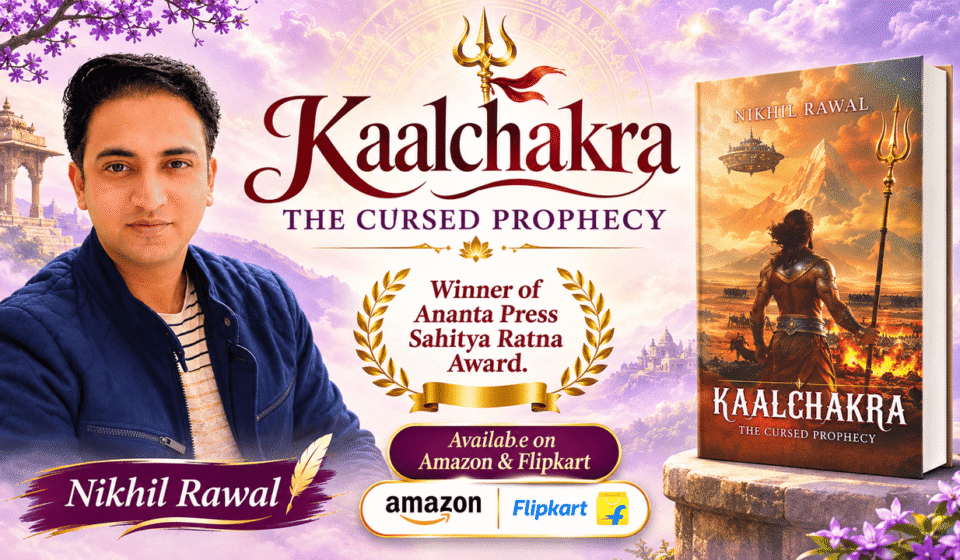
The cover art contributes effectively to the genre invitation. It presents an armored figure from behind, looking toward a mountainous landscape under an intense sky. A trident-shaped weapon commands the right side of the composition, while a hovering structure introduces a striking speculative note. The combination visually communicates mythic scale and futuristic possibility without revealing a precise plot event. The fiery terrain and distant ranks of figures suggest conflict on a vast stage. Importantly, this is a comment on the supplied cover rather than evidence of scenes in the novel. As packaging, it prepares the reader for a dramatic world where recognizable symbols of Indian myth may coexist with speculative imagery, echoing the hybrid promise made in the book description.
World-building becomes memorable, however, through consequence rather than size alone. A story can contain a hundred realms and still feel thin if none of them requires the protagonist to revise a belief. Conversely, one carefully imagined confrontation can imply an entire civilization if its moral and historical weight is felt. Rawal’s synopsis suggests an ambitious journey through different ages and dimensions, and its success for a full reader will depend on how clearly those transitions are handled and how thoroughly they change Vishwa’s understanding. That remains a question for reading the full novel, not a feature that can honestly be certified from promotional material. As an imaginative proposition, though, the design is coherent: history is not decorative background, mythology is not a list of references, and time itself is part of the narrative’s pressure.
There is a refreshing confidence in a debut novel that attempts to accommodate adventure, spiritual inquiry, and cosmic science-fiction influences within one project. Such breadth carries risks: a dense mythology may need patient explanation, and frequent shifts in scale may demand careful pacing. Yet the rewards can be substantial for readers willing to enter a layered fictional system. A story about ancient prophecy becomes more absorbing when every revelation raises a further question about the rules and values governing existence. A journey across realms becomes more meaningful when the protagonist discovers that the same moral dilemma follows him wherever he travels. The synopsis indicates that Rawal is interested in precisely these points of connection between spectacle and thought.
Kaalchakra – The Cursed Prophecy therefore deserves attention from readers looking for Indian-rooted epic fantasy with aspirations beyond retelling an established legend. Its appeal lies in the attempt to construct a new adventure out of inherited symbols, cosmic questions, and a modern protagonist’s unsettling discovery. Vishwa’s threatened world is both vast and intimate, while the title’s wheel suggests that beginnings and endings may prove less separate than they appear. Without the full manuscript, one cannot judge the consistency of the world-building or the execution of the science-fiction strand. What the supplied materials do establish is a clear and appealing creative direction: a fantasy universe built to ask why creation should endure, what Dharma demands in a broken age, and whether any destiny can remain unchanged once a human being chooses to resist it.
AMAZON / BOOKSTORE LINK