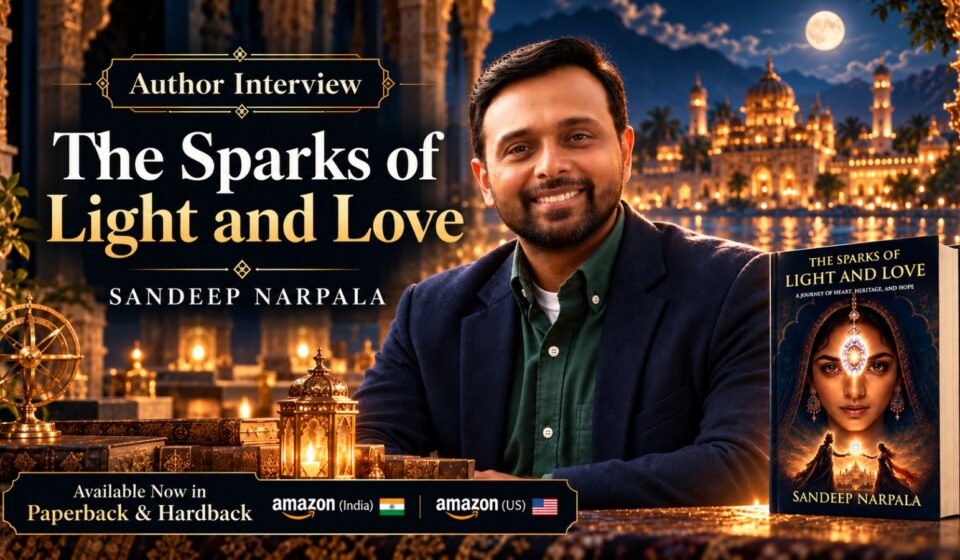

What happens when history is no longer something you read about, but something that begins to shape your identity?
For Sandeep Narpala, that question sits at the heart of The Sparks of Light and Love: A Journey of Heart, Heritage, and Hope. His debut novel takes one of the world’s most contested historical objects, the Kohinoor diamond, and places it inside a contemporary story of love, identity, crime and belonging.
Sandeep approaches fiction from an unusual vantage point. A scientist by profession, he is accustomed to evidence, experimentation and the possibility that an early answer may need to be reconsidered. Writing fiction introduced a different kind of inquiry, one where emotional truth could be just as important as historical fact.
The novel’s protagonist, Prince Suryanarayana, occupies a similarly complicated space. His Indian heritage and British connections place him between two histories, while his relationship with Vajra turns the Kohinoor from an object of political debate into something intensely personal. Her visions connect her physical survival to the diamond’s past, forcing Prince to confront how far he is willing to go for someone he loves.
At its core, The Sparks of Light and Love asks questions that extend beyond the diamond itself: Who gets to claim heritage? Can belonging exist between two cultures? And what happens when the past refuses to remain in the past?
We spoke to Sandeep Narpala about science and storytelling, the making of Prince and Vajra, the role of family in his decade-long writing journey, and why he hopes the novel will bring the Kohinoor back into conversation with a new generation.
You are a scientist entering fiction. Where do those two identities meet?
Sandeep Narpala: Science taught me patience, evidence and the willingness to accept that an early answer may be wrong. Fiction asked for many of the same qualities, although the proof is emotional rather than experimental.
I had to test scenes, remove what failed and listen when a reader did not believe a character. Storytelling became a new and unexpected passion, but it was not completely separate from the discipline I already knew.
Why did you want the Kohinoor debate to return to public conversation?
Sandeep Narpala: The argument has never truly ended, but it often appears briefly in the news and then disappears. I wanted people in India, especially younger readers, to talk about the diamond’s history and keep talking about it.
Heritage can be lost when each generation assumes somebody else will remember. Fiction can bring the question close enough that readers feel it rather than merely recognise the name.
Prince stands between India and Britain. What did that position allow you to explore?
Sandeep Narpala: It prevented the conflict from being simple. Prince’s citizenship, education and career connect him to Britain, while his heritage connects him to India and the history of the diamond.
He cannot make a choice without risking part of his identity. That tension reflects the larger problem of belonging: a person can carry two homes and still feel the pressure of a history that asks them to choose.
Vajra’s suffering turns history into something physical. Why was that connection important?
Sandeep Narpala: I wanted the past to have a human pulse. If Vajra’s health is tied to the visions, the history cannot remain a list of dates or rulers.
Prince must respond because someone he loves is in danger. Her condition makes the diamond’s past active in the present, and it forces the question of how much he is willing to sacrifice to save her.
How did you prevent the historical subject from overwhelming the love story?
Sandeep Narpala: I kept returning to one test: would Prince and Vajra still matter if the diamond vanished from the chapter? If the answer was no, the scene needed more work.
The Kohinoor gives the novel scale, but scale is not emotion. Their choices, fears and trust needed to remain clear enough that the historical material deepened their relationship instead of replacing it.
What did Bindhu contribute during the book’s long development?
Sandeep Narpala: She did more than encourage me. She argued with the story for nearly ten years. That is a different and very valuable kind of love.
She heard scenes, challenged choices and refused easy answers. I also had to learn that writing should never make the people who love you compete with the manuscript. The book had to become worthy of the hours the family had already given it.
Why did you choose a short, quick and accessible reading experience?
Sandeep Narpala: I am not an avid reader myself, and I have read only a limited number of books. I have always liked the plain and fast style of Chetan Bhagat because the books are meant to be finished.
I wanted this novel to welcome non-readers. It should wake the imagination without asking somebody to pass a literature examination before they can enjoy the story.
The book is now moving from the private world of your manuscript into the hands of readers. How are you introducing it to them?
Sandeep Narpala: Slowly and in my own voice. Instagram is a place where people who watched the manuscript develop can now watch it enter the world.
The book is available internationally through Amazon and through Indian platforms. I am asking family, school/college friends and early supporters to read it and leave honest reviews. A debut begins with that first circle.
I also plan a small gathering in Frederick, Maryland, and I am working with independent book marketers such as MISSBOOKTHIEF in India.
Why did you connect the book with support for Sialidosis families?
Sandeep Narpala: Sialidosis is a rare inherited condition that many readers will never have encountered. Families live with medical, financial and emotional pressure while receiving very little public attention.
A portion of the book’s earnings will support people carrying that burden. The story uses the language of light and hope, and I wanted some of that hope to become a practical act beyond the fiction.
After a decade spent finishing this story, what comes next?
Sandeep Narpala: I have two other stories in mind, but I am not rushing them. I chose The Sparks of Light and Love first because I believed it was the strongest story I had to offer.
The lesson of the decade is to respect the time a story needs while still insisting that it reach completion. Whatever comes next must earn the same commitment.
About the Author
Sandeep Narpala moves between two forms of inquiry: scientific research and storytelling. His professional life trained him to respect evidence, while his first novel asked him to trust imagination, emotion and moral uncertainty.
Candid about being a new writer and a selective reader, Sandeep has approached his debut with a particular reader in mind: people who may not usually choose a novel but are willing to follow a compelling story. He shares the book’s journey through Instagram at @sandeepnarpala and prefers to introduce the work one reader at a time.
Family remains central to his writing journey. His wife, Bindhu, challenged and questioned the manuscript throughout its development, while his children gave the long process a deeper sense of purpose. For Sandeep, the completed book ultimately became an example of what perseverance can make possible.
About the Book
The Sparks of Light and Love: A Journey of Heart, Heritage, and Hope brings together historical fiction, romance and crime around the Kohinoor diamond.
When the legendary stone is stolen, gemologist Prince Suryanarayana becomes caught between his professional expertise, his Indian heritage and his British connections. His relationship with Vajra adds another layer of urgency when her visions connect her physical survival to the diamond’s troubled past.
As the story moves between personal sacrifice and historical conflict, the novel explores colonial memory, questions of ownership, divided identity and the difference between possessing heritage and belonging to it.
Read and Purchase
Goodreads: The Sparks of Light and Love on Goodreads
Amazon India: The Sparks of Light and Love on Amazon India
Amazon.com: The Sparks of Light and Love on Amazon.com
Ziffybees.com: The Sparks of Light and Love on Ziffybees.com