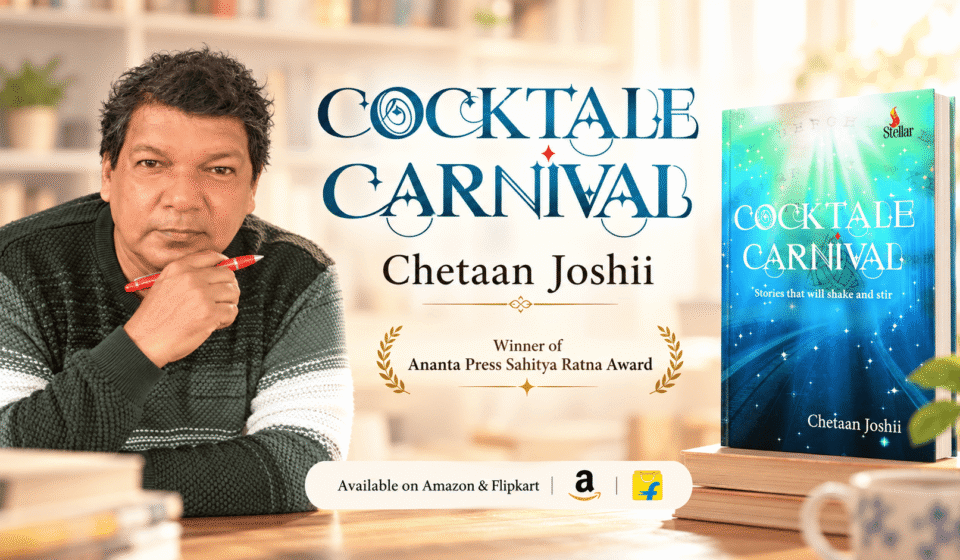

CockTale Carnival by Chetaan Joshii deserves serious appreciation not only as an entertaining collection, but also as an impressive demonstration of the short story form. The book may appear light-footed and playful on the surface, but beneath that lively exterior lies disciplined literary craftsmanship. Writing a strong short story is very different from writing a novel. A short story must establish mood quickly, introduce conflict efficiently, sustain intrigue, and leave the reader with a sharp emotional or intellectual aftertaste. In this collection, Chetaan Joshii repeatedly proves that he understands these demands well. The result is a body of work that feels energetic, surprising, and carefully constructed.
One of the defining strengths of this collection is its control over premise. A short story often lives or dies by the power of its central idea. CockTale Carnival thrives because its ideas are striking from the outset. A writer trapped in writer’s block entering his own story, a detective searching for a stolen heart, a medium turning planchette into a murder weapon, or a scientist discovering that love is a radioactive element—these are ideas that instantly generate curiosity. They compel the reader to continue because they pose implicit questions. What does such a world look like? How will this situation unfold? What symbolic or emotional meaning will emerge from the concept? Joshii uses premise not as a gimmick, but as a structural engine.
There is also admirable economy in the way the collection appears to work. Good short stories rarely waste space, and the spirit of this book suggests a writer committed to compression without thinness. The stories promise an immediate sense of movement. Instead of overexplaining, the author trusts a single unusual image or situation to carry narrative charge. That confidence is important. In short fiction, excessive elaboration can weaken impact. Joshii seems to understand when to let a striking idea breathe and when to move swiftly toward an emotional or ironic turn. This rhythm is central to the reader’s pleasure.
Another notable quality is the collection’s tonal control. The book travels across fantasy, horror, humour, realism, satire, science fiction, surrealism, and modern fable, and such variety could easily result in inconsistency. Yet diversity in tone is precisely what gives the book its vitality. The author shows awareness that each genre requires a distinct narrative attitude. Humour demands timing, horror demands atmosphere, fantasy requires imaginative conviction, and satire benefits from sharp observation. A writer who moves across these territories successfully demonstrates adaptability as well as command. CockTale Carnival becomes a showcase of that adaptability.
The collection is also meaningful as an exploration of literary voice. A book spanning so many genres must avoid sounding mechanically uniform. Even when the author’s sensibility remains a unifying factor, the stories need different textures. The world of a surreal piece cannot feel identical to the world of a satirical one. From the description and the author’s larger literary background, it is clear that Joshii has long resisted being trapped in one stereotypical mode. This book reflects that artistic philosophy beautifully. Each story seems to be allowed its own internal logic, and that freedom is one reason the collection feels alive. Readers are not just reading one kind of story repeated in different clothing. They are encountering a series of narrative experiments, each seeking its own ideal form.
A particularly attractive element of the collection is its embrace of the twist in perspective. The synopsis hints at stories that reinterpret familiar ideas through an unexpected angle: a love triangle existing between two people, a writer cursed by O. Henry, a mousetrap redefined by a mouse, an ugly duckling re-examined. These concepts suggest that Joshii is interested not only in storytelling, but in the reframing of storytelling conventions. That makes the book rewarding for attentive readers. There is pleasure in recognizing a familiar pattern and then seeing it turned inside out. Such writing refreshes literary experience.
The emotional architecture of the collection is equally important. Readers often think of short stories as intellectual exercises or quick narrative amusements, but their best versions carry emotional force precisely because of their concentration. CockTale Carnival appears designed to move the reader through amusement, intrigue, pathos, surprise, and other tonal variations. That range is significant because it prevents the collection from being reduced to cleverness alone. Clever ideas may attract attention, but emotional resonance creates lasting value. When a story can make a reader laugh, wonder, and then reflect, it transcends novelty.
The author’s background as a creative writing mentor becomes relevant here. Chetaan Joshii has spent decades engaging with the writing process, mentoring others, and developing techniques to make writing more effective and evocative. This long association with the craft shows in the conceptual confidence of the book. Yet the collection never feels merely pedagogical or overdesigned. Instead, it demonstrates something better: lived engagement with literature. It feels shaped by a writer who has read deeply, experimented widely, and remained committed to the joy of narrative discovery.
The book also stands out within Indian English writing because of its refusal to confine itself to realism as the only respectable literary mode. Much contemporary fiction gains prestige by staying close to social reality, psychological interiority, or domestic drama. Those are valuable traditions, but they are not the only traditions. CockTale Carnival reminds readers that literature can be fanciful, bizarre, comic, and fabulist while remaining artistically worthwhile. In fact, by mixing satire, surrealism, fantasy, and emotional insight, the collection expands what readers may expect from Indian short fiction in English. It opens space for literary play.
The inclusion of animal-based fables is particularly skillful in this regard. Fables are one of the oldest storytelling forms, and yet when refreshed with originality they retain powerful appeal. Through animal protagonists, a writer can create distance that sharpens human truth. Vanity, self-discovery, foolishness, resilience, and perception all become easier to dramatize when placed in such symbolic narratives. By including these alongside more contemporary or experimental tales, Joshii links ancient storytelling impulses with modern literary sensibilities. That combination enriches the collection’s formal identity.
What also impresses is the collection’s likely reread value. Books built on straightforward plot can be satisfying once, but collections built on concept, layered irony, and tonal variety often deepen on rereading. A reader returning to CockTale Carnival may notice new implications in its metaphors, additional humour in its reversals, or subtler commentary beneath its playful surfaces. That is an important literary virtue. It means the book is not disposable entertainment. It invites repeat engagement.
In the final analysis, CockTale Carnival succeeds because it respects the short story as a dynamic, flexible, and potent form. It is inventive without being chaotic, smart without being cold, and varied without feeling random. Chetaan Joshii demonstrates that short fiction can hold a universe of possibilities when guided by imagination and craft. The stories promise surprise, but they are anchored in narrative intelligence. For readers who appreciate the architecture of storytelling as much as the thrill of reading, this collection offers much to admire.
CockTale Carnival is therefore more than a miscellany of quirky tales. It is a well-conceived and artfully executed collection that reveals the many strengths of the short story tradition. It entertains the casual reader, engages the serious reader, and inspires the aspiring writer. That combination is rare, and it makes this book a particularly worthwhile addition to the shelf of any fiction lover.
Amazon Link:
https://www.amazon.in/dp/9382035176