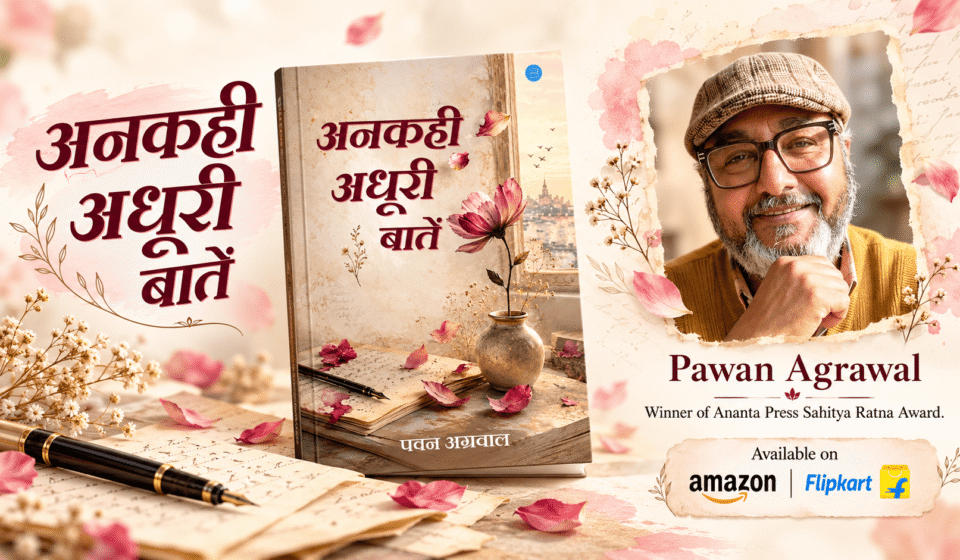

Poetry often begins where ordinary conversation ends. A person may be able to describe what happened, but not what it meant emotionally. They may recount a disagreement, a relationship, a disappointment, or a difficult phase, yet still feel that the most important part remains unspoken. Pawan Agrawal’s “अनकही अधूरी बातें” is built around this gap between experience and expression. It gathers Hindi poems written across the years and turns personal observations into a literary record of emotions that are familiar to many people but not always easy to articulate.
The phrase “collection of poems written over the years” is significant because it suggests growth, accumulation, and changing perspective. A book written in a short creative burst often captures one emotional season. A collection developed over a longer period can carry multiple versions of the self. The person writing after a difficult incident is not exactly the same person looking back months or years later. That temporal layering gives personal poetry a special richness. The poems become not only responses to events but markers of how the writer has seen life at different moments.
“अनकही अधूरी बातें” draws from a broad emotional landscape. The author identifies marital concerns, sibling relationships, an anti-money-driven mindset, and adverse circumstances as some of the experiences behind the writing. These themes may sound diverse, but they share a common centre: human relationships and values. Each asks, in a different way, what truly matters when people live closely with one another. Marriage asks how two people negotiate expectations and vulnerability. Sibling relationships ask how affection survives familiarity and difference. A critique of money-centred thinking asks whether material success can replace emotional connection, dignity, or integrity. Difficult circumstances ask what remains of a person when comfort is removed.
This makes the collection particularly relatable. Readers do not need specialised literary knowledge to enter these subjects. Most have witnessed family tension, financial pressure, emotional misunderstanding, or the struggle to say what they really feel. The book’s uniqueness comes from the author’s decision to preserve such experiences in poetic form rather than converting them into advice. Advice tells the reader what to do; poetry allows the reader to feel, compare, remember, and decide. This difference gives the collection a more open and humane quality.
Agrawal describes his work as an honest attempt to shape feelings rather than an effort to deliver “profound wisdom.” That modest artistic position is one of the book’s greatest strengths. Literature can become less persuasive when it strains to sound important. By contrast, simple personal observation can achieve depth naturally if it is emotionally accurate. A line about disappointment within a relationship may reveal more about human behaviour than a page of abstract philosophy because it comes from a recognisable situation. The collection appears to trust this principle: significance can emerge from sincerity rather than from intellectual display.
The book also highlights one of poetry’s oldest functions—emotional release. Writing something that one might never say aloud can transform the relationship between the writer and the feeling. The feeling is no longer only internal; it has been observed, arranged, and given form. The act of writing does not necessarily solve the original problem, but it changes it. Pain becomes language. Confusion becomes a sequence of images or thoughts. Anger can become reflection. Affection can become remembrance. In this sense, “अनकही अधूरी बातें” can be read as a record of emotional processing as much as a literary collection.
This quality may resonate especially strongly with readers who keep journals, write private notes, or have ever composed a message and then chosen not to send it. There is something universal in the urge to formulate words for feelings that cannot be delivered directly. The collection takes that private impulse and makes it public without pretending that every emotion has been neatly resolved. The word “अधूरी” — incomplete — is crucial. Human beings often live with unfinished explanations and unfinished emotional conversations. A poem can honour that incompleteness rather than forcing closure.
The author’s background as an advocate creates another layer of interest. Professional legal work depends on articulation: facts must be organised, positions must be stated, contradictions must be noticed, and language must be controlled. Poetry, however, permits ambiguity. It can allow two opposing feelings to exist together. It can admit uncertainty. This contrast makes Agrawal’s literary inclination compelling. A person trained to argue and define may turn to poetry precisely because some experiences resist final definitions. The result is an appealing tension between observational clarity and emotional openness.
The book’s engagement with money-centred values is also timely. Modern life frequently measures achievement through salary, possessions, status, and visible consumption. These measurements are easy to compare, which makes them socially powerful. Emotional wealth—trust, generosity, companionship, contentment—is harder to display or quantify. A poetic voice that questions the dominance of money therefore speaks to a widespread unease. The issue is not whether money matters; it clearly does. The deeper question is what happens when it becomes the primary lens through which people evaluate themselves and one another. Poetry can explore the emotional cost of that shift in a way that a financial or sociological discussion cannot.
Marital and sibling themes similarly place the book close to the social reality of Indian readers. Family relationships often carry both deep affection and strong expectations. Individuals may hesitate to speak openly because words can disturb long-established bonds. This creates precisely the kind of emotional residue from which poetry emerges. A poem can say, “This is how it felt,” without demanding that the other person agree. It creates a private truth that can later become a shared artistic experience.
The title “अनकही अधूरी बातें” elegantly gathers these concerns. “Unsaid” suggests restraint, silence, and withheld truth. “Incomplete” suggests that even when something is expressed, it may not be fully resolved. “Things” or “conversations” suggests everydayness rather than grand abstraction. Together, the words prepare the reader for a collection of fragments, reflections, and feelings rather than a rigid thematic treatise. It is a title that invites intimacy.
From a literary perspective, the collection’s value lies in its commitment to observation. The author is not attempting to separate poetry from life; he is using poetry to look at life more carefully. That approach has a long and respected place in Hindi literature, where personal feeling, social observation, relationships, ethical reflection, and everyday speech have often intersected. A contemporary reader may appreciate how this collection carries that impulse into familiar modern concerns.
The book can appeal to several kinds of readers. Those already fond of Hindi poetry may enjoy its personal and reflective tone. Readers who usually prefer prose may find its accessible subjects an inviting entrance into poetry. People interested in writing may be encouraged by the example of a professional from another field sustaining a literary practice over time. Most importantly, readers who have struggled to express difficult feelings may find companionship in a book that openly acknowledges the existence of unsaid thoughts.
“अनकही अधूरी बातें” stands out because it does not treat personal experience as too ordinary for literature. It suggests the opposite: the ordinary becomes meaningful when we pay close attention to it. The collection’s mixed emotions, relationship themes, critique of excessive materialism, and emphasis on honest self-expression create a textured portrait of everyday human life. Its likely impact is not in offering final answers but in awakening recognition. The reader may close a poem not with a lesson, but with a memory—and sometimes that is exactly what good poetry is meant to do.Amazon Purchase Link: https://www.amazon.in/dp/8169956668