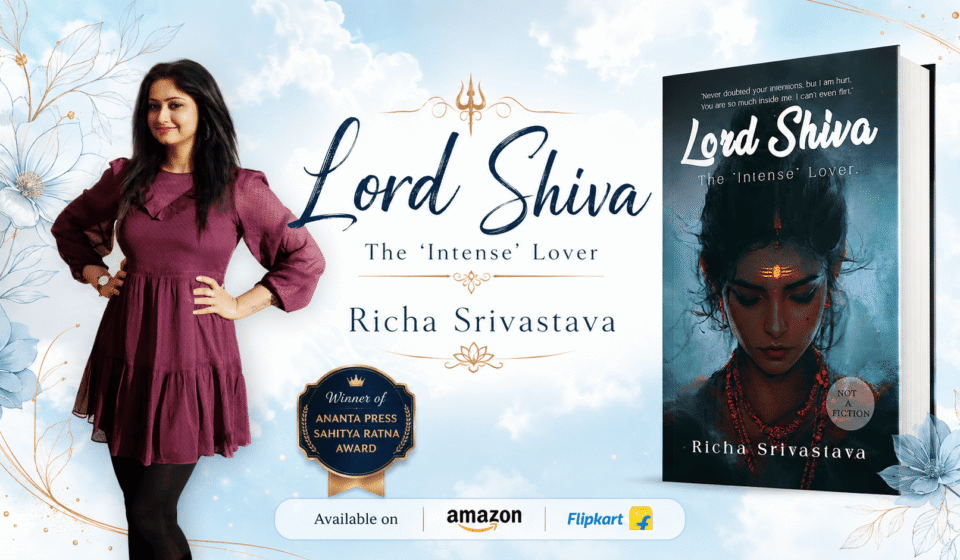

Lord Shiva – The “Intense” Lover by Richa Srivastava is built around a powerful idea: that the sacred may enter a person’s life not only through temples, scriptures, or inherited traditions, but through private events that feel impossible to dismiss. Described as an autobiography containing supernatural experiences and real incidents, the book occupies a fascinating space between memoir and spiritual testimony. It asks the reader to accompany the author through events that are meaningful precisely because they were lived rather than invented.
The first thing that distinguishes the book is its refusal to separate emotion from spirituality. In many religious works, devotion is described in respectful but formal language. Here, the title suggests closeness, intensity, and even emotional turbulence. “The Intense Lover” is an unusual description for Lord Shiva, yet it is precisely this unusual phrasing that gives the book its voice. It presents divine love as something personal and transformative, something that may comfort the devotee but may also unsettle, test, and reshape her.
Autobiographical spiritual writing depends greatly on trust. The author must trust the reader with experiences that may be difficult to explain, while the reader must enter the narrative without demanding that every mystery be reduced to a simple conclusion. Srivastava’s premise encourages this kind of open reading. The book is not merely a collection of extraordinary incidents. Its deeper interest lies in the author’s interpretation of those incidents and in the emotional consequences that follow. What changes when a person begins to believe that a divine presence is communicating through life events? How does such a belief influence courage, decision-making, relationships, and identity? These questions give the work depth.
The supernatural element naturally attracts attention, but the autobiographical structure prevents the book from becoming only sensational. Real incidents carry a different weight from fictional suspense. The reader is aware that the author associates these moments with her own life, memory, and faith. This awareness invites sensitivity. One may agree with every interpretation, question some of them, or read them as symbols of inner transformation, but the emotional truth of the narrative remains significant.
A particularly compelling aspect of the book is the possibility that Lord Shiva functions on multiple levels within the memoir. Shiva may be understood as the deity worshipped by the author, as a protective presence, as a symbol of destruction and renewal, or as a spiritual mirror through which the author examines herself. This multiplicity makes the subject rich. Shiva is not a one-dimensional figure. He represents ascetic stillness and passionate power, withdrawal and compassion, death and regeneration. A memoir shaped by such a figure can naturally explore contradictions within the human heart.
The author’s own life profile makes the book even more intriguing. Richa Srivastava has worked across intellectual property, content, entrepreneurship, counselling, motivational speaking, and writing. She has also been publicly recognised through awards in business, leadership, literature, and communication. These accomplishments reveal someone familiar with visibility, achievement, and professional ambition. A spiritual autobiography from such an author offers a valuable perspective because it shows that mystical inquiry is not limited to those who withdraw from worldly life. Spiritual searching can occur in the middle of careers, responsibilities, public recognition, and personal aspirations.
This intersection of professional confidence and spiritual vulnerability is one of the book’s most distinctive qualities. Public achievements are measurable: awards, enterprises, publications, and records can be listed. Inner experience is different. It is intimate, uncertain, and often resistant to proof. By placing the two dimensions side by side, the book suggests that a person can be accomplished in the external world and still carry profound questions within. This makes the narrative relevant to contemporary readers who may appear successful yet continue to seek emotional and spiritual grounding.
The book also has value as a study of meaning-making. Human beings do not experience life as a neutral sequence of events. We connect incidents, remember patterns, interpret signs, and create stories that help us understand suffering and change. A supernatural memoir makes this process visible. The author’s experiences become part of a larger spiritual narrative in which pain may have purpose, coincidence may become communication, and personal change may be understood as divine intervention.
Such writing is most effective when it remains emotionally honest rather than overly instructional. The power of a memoir comes from the details of how a person felt, doubted, reacted, and changed. Readers are often more moved by a sincere account of uncertainty than by a polished declaration of certainty. The premise of Lord Shiva – The “Intense” Lover promises an intimate voice, one willing to reveal not only devotion but also hurt. The line on the cover—expressing trust in divine intentions while admitting pain—captures this emotional complexity. Faith does not erase hurt; instead, faith becomes the language through which hurt is processed.
That tension between trust and pain is central to many spiritual journeys. People often turn toward the divine during difficulty, but they may also feel abandoned, confused, or tested. A mature spiritual memoir does not hide this contradiction. It shows that devotion can include complaint, longing, and emotional struggle. The book’s title therefore becomes even more meaningful: intense love is rarely simple. It involves closeness, expectation, vulnerability, and transformation.
The work is unique within general non-fiction because it combines several genres without being fully limited by any one of them. It is autobiographical, but it is also devotional. It contains supernatural experiences, yet its purpose appears to be emotional reflection rather than paranormal entertainment. It may inspire, but it is not presented merely as a motivational manual. This genre-blending gives the book a distinctive place among contemporary Indian spiritual narratives.
Readers may also appreciate the author’s ability to speak from personal conviction. Spiritual literature can sometimes become impersonal when it relies too heavily on familiar quotations or established interpretations. A memoir avoids this problem by returning to the author’s own life. Even when readers have encountered many books about Lord Shiva, they have not encountered this particular relationship, this sequence of incidents, or this emotional viewpoint. Individual experience becomes the source of originality.
The book can be approached by different kinds of readers. Devotees of Lord Shiva may read it as an affirmation of divine presence. Readers interested in supernatural accounts may focus on the unexplained incidents. Those drawn to memoir may appreciate the personal courage involved in disclosure. Psychologically minded readers may interpret the experiences as expressions of intuition, emotional need, or inner transformation. The book does not need to force all readers into one interpretation to remain valuable.
Its strongest message may be that spiritual experiences are meaningful not only because of what happened, but because of what they awaken. An event becomes transformative when it changes the way a person sees herself, her pain, and her path. In this sense, the memoir’s real subject is not simply the supernatural. It is the author’s evolving consciousness.
Lord Shiva – The “Intense” Lover is therefore a compelling example of personal spirituality written for a wider audience. It offers mystery, vulnerability, devotion, and reflection in a form that feels contemporary and intimate. The book stands out because it presents Lord Shiva not only as a mythological or philosophical figure, but as an emotionally present force within one woman’s life. That perspective makes the work memorable and gives it a sincerity that readers of spiritual autobiography are likely to value.
Amazon Link: https://amzn.in/d/0dpvsP2g