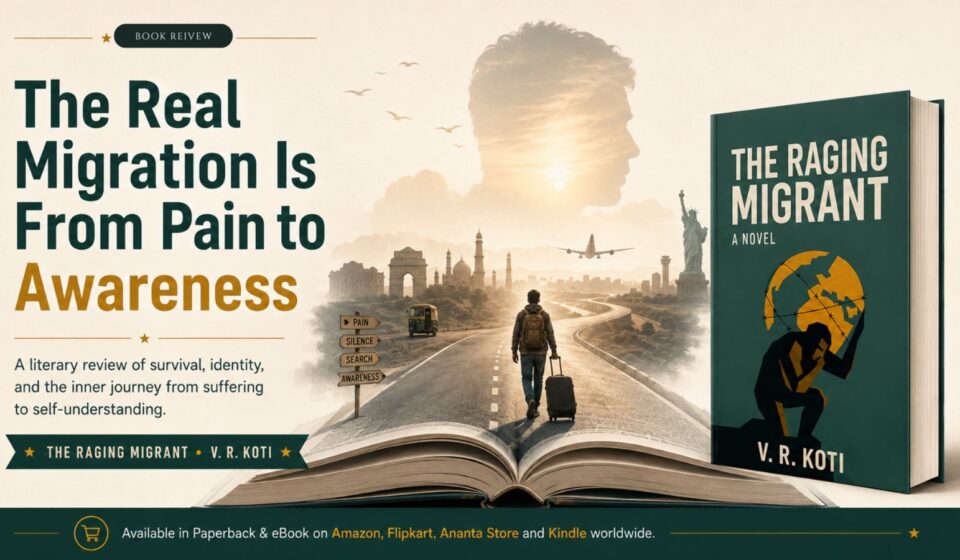

KK is not a loud hero. His strength comes from care, restraint, guilt, fear, and the long work of becoming morally awake.
One of the most refreshing qualities of The Raging Migrant is its portrayal of masculinity. In many novels about struggle, migration, violence, or ambition, the male protagonist is made heroic through dominance. He fights, wins, conquers, and silences doubt. V. R. Koti chooses a more human path. Krishna Kant Sharma, or KK, is not a conventional strongman. He is anxious, thoughtful, loving, uncertain, brave, ashamed, loyal, and sometimes impulsive. He wants to do the right thing, but he does not always know what the right thing is. That complexity makes him believable and important.
The novel is full of situations that test KK’s idea of manhood. He grows up around family dysfunction, bullying, debt, and emotional silence. He wants to become someone who will never be bullied again. He wants a future family built on mutual respect. He wants to buy back his mother’s jewelry. These are not small desires. They show a young man trying to convert pain into responsibility. But the book also asks whether responsibility can become a burden when it is mixed with unresolved anger.
KK’s experience of bullying is important because it shapes his later decisions. He has known humiliation. He has been pushed, mocked, and forced into degrading situations during hazing. He has learned how it feels to be powerless. This background gives emotional logic to his later attraction to Taekwondo and self-defense. He does not only want physical ability. He wants self-confidence, self-control, and dignity. The Taekwondo tenets – courtesy, integrity, perseverance, self-control, and indomitable spirit – become more than classroom chants. They become a moral framework that KK tries to live by, even when life becomes chaotic.
The attack on Piyush is one of the key moments in the book. KK is present when masked men invade their home and brutally assault his friend. He is frightened, physically overwhelmed, and unable to stop what is happening. Afterward, he cleans Piyush, seeks first aid, and cares for him. This scene is crucial because it redefines courage. KK’s courage is not shown through victory over attackers. It is shown through care after failure. He may feel guilt for not doing more, but the reader sees his humanity in the way he refuses to abandon his friend. He cleans blood. He runs for medicine. He stays.
This is why the book is emotionally strong. It understands that trauma often comes with guilt. Survivors frequently ask themselves what they should have done differently. KK wonders whether standing still was betrayal. This question stays with him and later affects how he responds to danger. When he sees Mira threatened or when violence appears in America, he is not reacting only to the present moment. He is also responding to the old feeling of helplessness. Koti handles this with psychological insight. KK’s bravery and impulsiveness are connected to his wounds.
The scene at Sarojini Nagar market, where KK protects Mira from a man with a knife, is another important test. On one level, it is a heroic scene. KK uses his training and prevents harm. On another level, the scene raises questions about danger, judgment, and the cost of direct action. Mira is worried because something could have happened to him. This is the novel’s strength: it does not simply celebrate male protection as romance. It asks whether the desire to protect can become reckless when it is powered by fear, anger, or the need to prove oneself.
The book’s treatment of violence is mature because violence never becomes entertainment. Physical confrontations leave marks. The body remembers. Wounds reopen. Pain returns. Fear enters sleep. The chapter The Body Never Forgets makes this idea clear. Trauma in the novel is not only emotional memory; it is physical reality. KK’s injuries, anxiety, dreams, and bodily reactions show that the past lives in the nervous system. This makes the novel relevant to readers who understand that trauma is not solved by simply being strong.
The American chapters deepen this theme. KK arrives in the United States with hope, pressure, and unresolved emotional baggage. He enters a new system where he must learn rules, culture, survival, and self-presentation. But America is not only opportunity. It is also a place where suspicion, violence, and isolation exist. The gun incident involving his roommates becomes a devastating turning point. A day already emotionally connected to 9/11 becomes linked to another violent event. KK is again confronted with danger, fear, and the impossible question of whether to step back or act.
What makes KK compelling is that he is not always calm or wise. He is learning. He sometimes reacts from old pain. He sometimes tries to be useful when he should protect himself. He sometimes carries guilt as if guilt were proof of love. But the book allows him to grow. His journey is not from weakness to dominance. It is from reaction to reflection. That is a more meaningful model of masculinity.
The therapy scenes are especially important because they bring emotional honesty into a story where men might otherwise be expected to suppress pain. KK is asked to examine love, negotiation, family patterns, anger, and internal responsibility. These scenes matter because they show that healing is not only about surviving an event. It is about understanding how one’s past shapes one’s reactions. A man who can fight may still need to talk. A man who can protect others may still need help. A man who feels responsible for everyone may still need to learn boundaries.
This makes The Raging Migrant important for modern readers. Many cultures teach men to be strong by being silent. They are expected to provide, protect, endure, and avoid vulnerability. KK’s story challenges that model. He is strongest when he is willing to care, admit confusion, seek meaning, and question himself. He is not less masculine because he feels fear. He is more human because he recognises it.
The novel also explores moral responsibility. KK’s life repeatedly places him near other people’s suffering: his mother’s sacrifices, his father’s decline, Piyush’s injuries, Mira’s fear, roommates’ danger, and family disputes. He wants to respond ethically. But moral responsibility is difficult when every choice has a cost. If he stays home, he may sacrifice his future. If he leaves, he may feel he has abandoned his family. If he protects Mira, he risks injury. If he avoids action, he risks guilt. If he pursues ambition, he may lose emotional connection. These dilemmas make the novel intellectually engaging.
Koti’s background in systems thinking is visible in this moral structure. The book does not treat events as isolated. Family debt leads to migration pressure. Bullying leads to a desire for self-defense. Violence leads to trauma. Silence leads to relational breakdown. Cultural expectations affect marriage. Immigration systems shape identity. Every part of the story is connected. KK is not merely making individual choices in a vacuum; he is moving through systems of family, class, masculinity, law, race, education, and love.
The title The Raging Migrant becomes especially interesting in this reading. The rage is not simple anger against a country or a person. It is the pressure built inside someone who has endured too much without a safe way to process it. KK’s rage is mixed with compassion. He is not hateful. He is disturbed by injustice, powerlessness, and humiliation. The novel asks what happens when a sensitive person lives in a world that often rewards hardness. Can he remain gentle without being crushed? Can he become strong without becoming cruel?
The answer the book offers is not easy, but it is hopeful. KK’s strength develops through accountability. He begins to understand that courage is not the same as impulse. Love is not the same as control. Protection is not the same as possession. Silence is not the same as peace. Migration is not the same as freedom. These realisations make him more mature. He does not become perfect, but he becomes more awake.
The supporting characters help reveal this growth. Piyush, with his reading habit and vulnerability, gives KK a model of friendship beyond surface masculinity. Ashish helps him imagine bigger possibilities. Mira challenges his understanding of love and safety. Yatzil and the therapy framework help him process what he has experienced. Even antagonistic figures and violent situations become mirrors in which KK sees his own limits. The novel’s world is therefore not only plot-driven; it is character-shaping.
The prose supports this theme effectively. Koti often describes physical sensations: sweating, trembling, pain, exhaustion, a racing heart, injuries, teeth grinding, nightmares, and bodily shock. These details matter because they make internal conflict visible. Rather than telling us that KK is traumatised, the novel lets us feel how trauma appears in daily life. The body becomes a text that the reader learns to read.
For readers interested in literary fiction, this gives the book depth. For readers interested in immigrant stories, it adds emotional realism. For readers interested in men’s mental health, it provides a valuable portrayal of vulnerability without self-pity. The novel does not preach, but it quietly argues that emotional honesty is a form of courage. That is a message worth paying attention to.
Why should someone read The Raging Migrant for this reason? Because it gives us a male protagonist who is allowed to be complicated. KK is not reduced to success, romance, anger, or victimhood. He is a young man trying to become ethical under pressure. His mistakes are understandable. His courage is imperfect. His love is sincere but sometimes immature. His ambition is admirable but emotionally loaded. This fullness makes him memorable.
The book is important today because conversations about masculinity are changing. Readers are looking for male characters who are neither invincible heroes nor empty symbols of failure. KK stands in the middle. He is wounded and responsible, afraid and brave, gentle and raging. He represents many young men who carry family expectations, career pressure, romantic uncertainty, and unresolved pain while trying to appear steady.
The Raging Migrant is available in paperback and e-book formats, with availability shared on Amazon, Flipkart, Ananta Store, and international platforms across 150 plus countries. Readers who want a thoughtful novel about migration, trauma, healthy masculinity, moral courage, and emotional growth should read it. This is not a book about a man conquering the world. It is about a man learning not to lose his humanity while the world keeps testing him. That is why it matters.